Scene
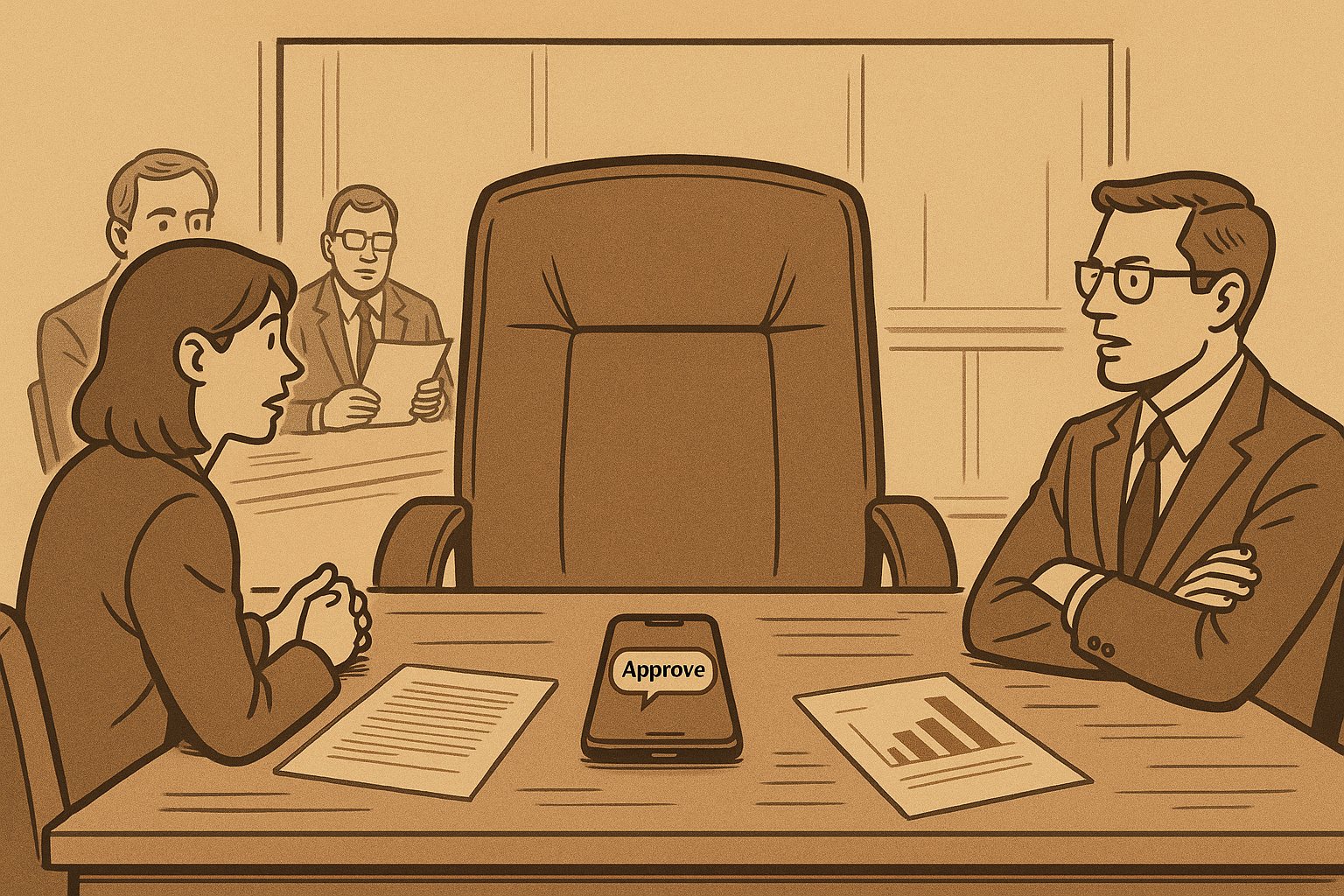
Four directors. Three attend every board meeting, read the packs, front staff briefings, carry the load. The fourth has stopped turning up. They send short emails instead: “Approve”, “Against”, “Need more info”. Their votes still count towards quorum. Their absence does not.
Over six months, the pattern hardens. Major decisions get delayed while the chair “checks with” the absent director. Staff know one name on the website never appears in the building. The finance lead refuses to move on a restructure because “the board isn’t united”. The other directors feel exposed. They are carrying execution risk while sharing liability with someone who has gone quiet.
Pattern: Formal Silence
The firm now runs with an authority gap. One director retains full legal power while abandoning operational responsibility. On paper, governance looks intact. In practice, legitimacy is eroding.
This is formal silence. The structure remains, the behaviour has gone. Decisions are still “approved” by email, but there is no scrutiny, no shared understanding, no real-time challenge. The active directors lose confidence in the process. Staff sense the split and start treating board approvals as paperwork, not leadership. That is the early stage of governance decay.
Analysis
Formal silence follows a predictable track.
1. Withdrawal. The director starts missing meetings, citing client work, health, or travel. Voting shifts to email. The board tolerates this because the register still looks complete.
2. Workarounds. The remaining directors shorten agendas, avoid contentious items, or pre-negotiate outcomes to “keep things smooth”. Real debate moves into side conversations.
3. Weaponised formality. The absent director uses formal rights without context. They block items they have not discussed or approve complex matters without reading them. Minutes become defensive. Packs get heavier. Meetings lengthen.
4. Legitimacy loss. Executives no longer believe decisions are well-founded. Regulators, lenders, and key staff start to notice gaps between who signs and who shows up. When a dispute emerges, the silent director claims “I was never properly informed”. The others face both legal and reputational risk.
Silence in governance isn’t neutrality; it’s decay.
Framework: Assess → Align → Act
Use the same Assess → Align → Act discipline applied in earlier briefings on exit drift and structural blindness.
Assess – What Is Actually Happening?
- List board meetings for the last 12–18 months: attendance, format (in person / online), and whether papers were circulated.
- Record how each director voted on key resolutions, including email approvals.
- Extract constitutional rules on quorum, deadlock, and director duties.
- Note any decisions executed on the authority of email consent alone.
- Identify which director is carrying execution risk for each major decision.
You now have a factual map of who is present, who is deciding, and where the constitution is silent or outdated.
Align – Who Owns What Obligation?
- Convene a live board discussion focused on role expectations, not personality.
- Agree minimum participation standards: attendance, preparation, and engagement.
- Set a clear rule: no quorum without live participation (in person or real-time online) except for defined emergencies.
- Clarify how deadlocks are resolved: chair casting vote, independent director, or shareholder mechanism.
- Use commercial criteria: risk exposure, time capacity, and future commitment.
Alignment means each director accepts that authority carries effort, not just status.
Act – Lock the New Rules In
- Update the board charter and, where needed, the constitution to reflect the new quorum and participation rules.
- Document a pathway for directors who cannot meet the standard: reduced role, observer status, or structured exit.
- For entrenched disengagement, move to a formal transition using The Overboard Protocol™ as the execution pathway.
- Set a quarterly review of attendance, contribution, and decision quality.
- Require that any exception to live participation be recorded with a clear end date.
The board must be able to show that decisions are both valid on paper and credible in practice.
Tool: The Board Silence Audit
One page, under an hour.
For the last six board decisions over a set value or risk threshold, record:
- Who was present live.
- Who voted, and how.
- Who carried execution responsibility.
- Whether the decision was challenged in the room.
- Whether any director later disowned or questioned the decision.
If the same director is absent more than twice yet voting every time, or if execution risk sits mainly with those most present, you have formal silence in progress.
Why It Matters
When authority detaches from participation, the firm loses operational legitimacy. Executives slow down, staff hedge, regulators look closer, and insurers ask harder questions. Email approvals will not protect a board where one director has opted out of the real work. Fixing this early preserves value and relationships. Fixing it late becomes a removal exercise.
If you see a silent director forming in one of your clients, introduce them to The Unravelling Map™ first and use The Overboard Protocol™ when transition is unavoidable. Refer early. It keeps everything cleaner.