Two partners in a professional firm. One has run the external profile for years. Conferences. Referrals. “Rainmaker.”
The other is reconciling a debtor ledger when a familiar client name appears on a third-party invoice. Same contact. Same project. Different entity as supplier. The ABN traces back to the rainmaker’s new company.
There is no disclosure in board papers. No note in the conflict register because there is no conflict register. Staff know something: they have seen work briefed “off system” and emails using a private domain.
The discovering partner freezes. If they confront it, they risk a split. If they ignore it, they condone it. Either way, the duty line has already broken.
Pattern: The Shadow Business
The Shadow Business is an undeclared conflict of interest that trades on the firm’s relationships, staff time, or intellectual property.
It grows in the gaps: no written related-party policy, no outside-interests register, no enforcement of duty of loyalty beyond the Corporations Act boilerplate. Partners tell themselves it is “temporary” or “separate” while using firm resources to test a side play.
On paper, everyone owes loyalty to the same entity. In practice, one partner is optimising for their own balance sheet. The firm becomes a distribution channel for a business no one else owns.
Analysis: How Hidden Interests Break the Firm
The sequence is predictable.
- Incubation
A partner starts a side entity. At first, it sits outside normal operations. They use firm time or contacts “just to get started.” No one asks for disclosure because there is no structured moment to disclose. - Leakage
Work, staff hours, and opportunities start moving off the firm’s systems. The partner justifies it as “not our kind of client” or “too small for the firm.” Staff receive mixed instructions about where to record time. Finance sees unexplained drops in margin. - Discovery
Another partner or senior staff member connects the dots. A shared client. A shared supplier. An email mis-sent. The issue moves from suspicion to evidence. Informal conversations become guarded. Emails lengthen. People start checking documents before speaking. - Reframing
The core question stops being commercial and becomes moral: “Can I trust you?” Historic decisions are re-interpreted through this lens. Normal risk becomes “you were lining your own pockets.” - Escalation
Once trust is gone, every step is adversarial. Forensic reviews. Legal advice. Emergency valuations. Staff are pulled into sides. Insurance and regulators become live risks.
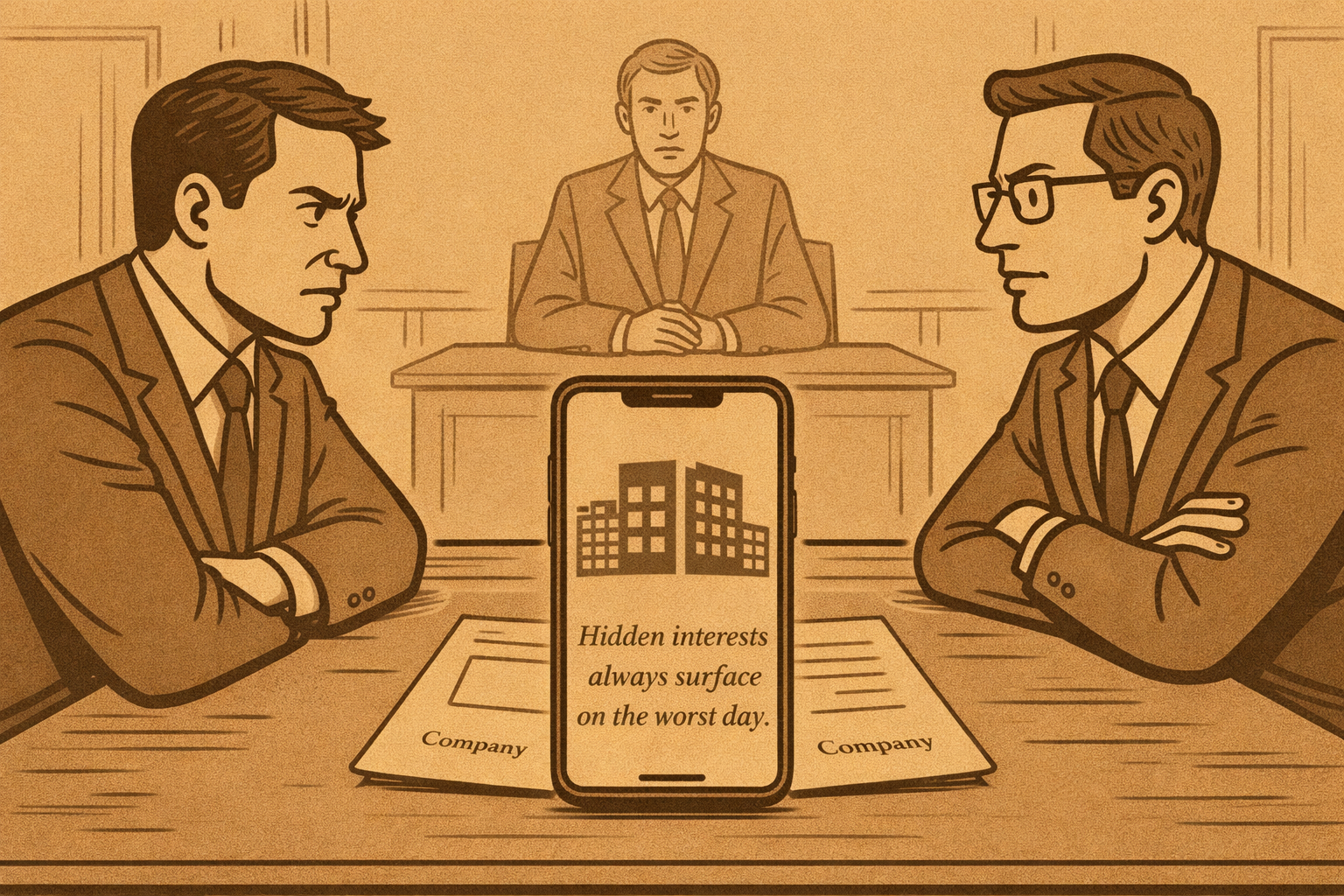
Hidden interests always surface on the worst day.
Framework: Assess → Align → Act
Assess – Make the Interests Visible
Start with a one-page capture of everything that could distort loyalty. For each partner, director, and key manager, list:
- All entities they control or influence.
- Any client or supplier relationships held personally.
- Any paid roles outside the firm.
- Any use of firm IP, branding, or staff in those activities.
Add a column for “Declared to Board? Y/N.”
This is not an accusation. It is a map.
Align – Decide the Rules of Loyalty
With the map in front of you, agree the rule set. Use commercial criteria.
- Which outside interests are compatible with the firm’s strategy?
- What thresholds require prior board approval?
- What must never happen: competing services, diversion of clients, use of staff or systems?
- What are the consequences of breach: reallocation of profit, forced sale, exit pathway?
Write these as specific tests. “No director may provide [service] to any person who is or has been a client of the firm in the last 24 months without written board approval.”
Act – Lock in the Register and the Response
Implement a written Related-Party and Outside-Interests Register.
- Make completion mandatory for all owners and key staff.
- Update on any change and review quarterly as a standing agenda item.
- Tie breaches to a pre-agreed protocol: investigation steps, valuation method, and options for separation or restructure.
This is where The Overboard Protocol™ sits: a structured path to unwind the relationship, re-set equity, or execute an orderly exit when loyalty has already fractured.
Tool: The 30-Minute Shadow Business Audit
Create a simple table with four columns:
| Person | External Entity / Role | Overlaps with Firm (clients, services, staff, IP) | Status (Approve / Prohibit / Review) |
Run it with the partners first, then senior staff.
If you need more than one line for any person, your conflict settings are already live.
Why It Matters
Undeclared conflicts are rarely about a single invoice. They attack the core asset in a professional firm: confidence that everyone is rowing in the same direction.
Once a Shadow Business appears, valuations compress, key staff reconsider their future, and regulators and insurers take a harder line. The legal dispute is the last stage. The real damage is done in the quiet months before discovery.
If a client’s firm shows signs of a Shadow Business, introduce them to The Overboard Protocol™ before loyalty failures turn into litigation.