
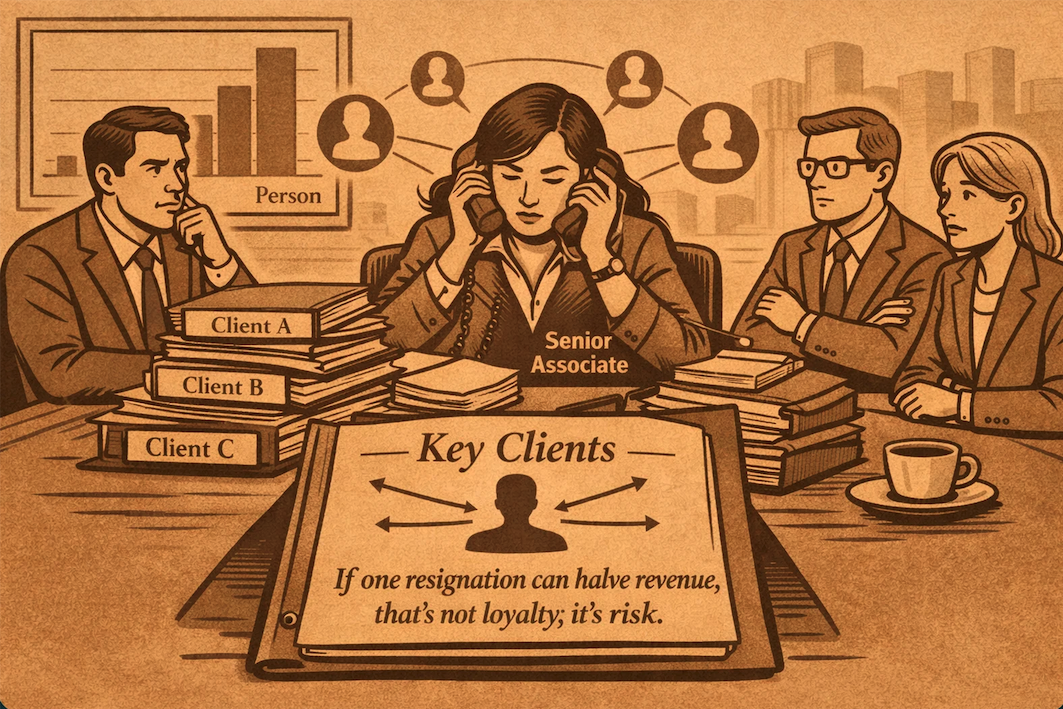
One senior client lead holds forty per cent of the firm’s revenue. Every major matter with any nuance goes to her. Clients email her directly. Partners describe certain clients as “hers”.
Her contract is the standard template. No extended notice. No restraints that match the exposure. No clear IP and client ownership provisions beyond boilerplate.
Signals build quietly. She is slower to return internal calls. She discourages juniors from joining client meetings. File notes are brief. The practice management system is light on detail. When she takes a day off, everyone waits for her return before speaking to key clients.
Then she resigns. Four weeks’ notice. Half the fee base relies on relationships and knowledge largely in her head. Within hours, clients ask for her personal contact details. The partners call a meeting. By that point, the structure has already failed.
Pattern: Revenue Concentration with Zero Control
This is the Key Person Trap. A single individual becomes the de facto owner of major clients, matters, and revenue.
The firm confuses personal loyalty with institutional control. Client relationships cluster around one name. Second-chair relationships are thin or absent. There is no deliberate rotation of client contact. Restraints, notice, and IP protections do not reflect the actual risk.
Everyone praises the “trusted adviser” status. No one measures how much of the firm’s value now sits with one person.
If one resignation can halve revenue, that is not loyalty. It is risk.
Analysis: How Dependence Turns into Dispute
The sequence is familiar in professional firms.
Concentration. High-value clients and complex matters are consistently directed to the same partner or senior manager. The logic is short-term efficiency and client comfort. Over time, the firm’s relationship with those clients is narrowed to one face and one inbox.
Insulation. The key person becomes gatekeeper. They manage client contact, shape the narrative, and filter information. Juniors are used for production work but do not sit in client conversations. File notes are partial. The system records what is necessary for billing, not continuity.
Leverage. Market demand lifts. A competitor offers equity, flexibility, or a new platform. The key person understands their bargaining position. They seek special terms or prepare to move. Partners respond late, with hurried contract reviews and improvised promises.
Escalation. On resignation, clients ask where the individual is going. Some follow. The firm asserts client ownership and restraint clauses. The departing person argues custom, weak documents, and client choice. Lawyers are briefed in a rush, based on incomplete records and inconsistent practice.
What is described as “poaching” is usually the final stage of a long structural decision: to allow client control to sit with one person instead of the firm.
Framework: Assess → Align → Act
Assess – Map Key-Client Exposure
Build a one-page view of key-person risk:
Use The Unravelling Map™ to overlay this with ownership, process, and documentation. You will see where a single departure can break continuity and cash flow.
Align – Decide Who Owns the Relationship
Bring the equity holders and practice leaders together with the map in front of them. Decide explicitly:
Base these decisions on revenue, sensitivity, and replacement difficulty. Do not base them on seniority alone.
Act – Institutionalise Rotation and Restraints
Turn decisions into visible practice:
Once written and repeated, these moves shift client reliance from a person to a firm.
Tool: Key Person Exposure Sheet (One Page)
In a single session with partners or practice heads:
Reds are live structural risks, not HR issues for later.
Why It Matters
Key-person dependence reduces valuation, weakens succession plans, and increases the chance of messy departures turning into urgent litigation. It also slows internal promotion, because rising practitioners never own relationships.
If one resignation can halve revenue, that is not loyalty. It is structural risk the owners have chosen to carry, often without seeing it.
If this describes one of your firms or clients, introduce them to The Unravelling Map™ before the resignation letter arrives.
