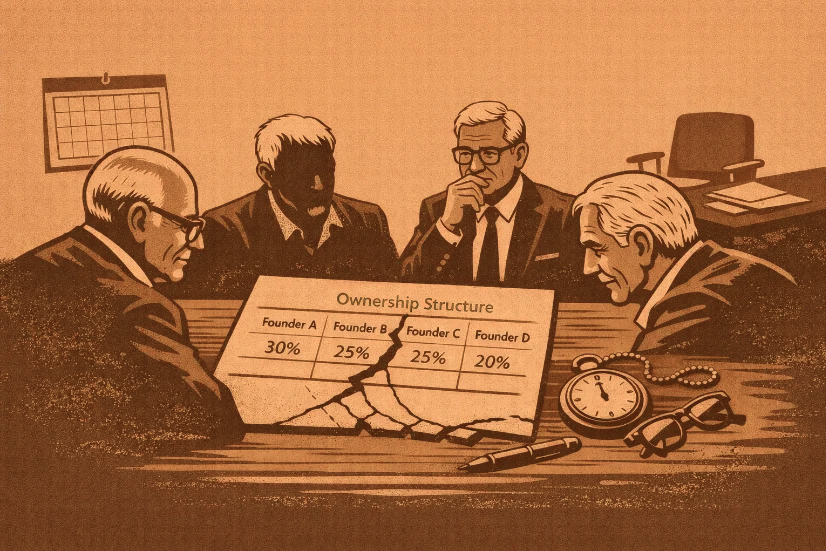
Four founders. All over 65. All still on the register. The firm has grown to fifty staff and steady profit. No one has written down who leaves first, who takes over key client relationships, or what happens to the equity.
The warning signs are already visible. One founder has reduced hours without changing title. Another still approves major spending but no longer attends operational meetings. Senior staff are carrying decisions upward, then waiting. The younger directors are careful around succession because every discussion feels personal. So nothing is said clearly.
The shareholders call it loyalty. The staff call it uncertainty. The structure is still intact on paper. The transition has already started in practice.
Pattern
Deferred Transition Planning
This is succession delay dressed up as respect.
In founder-led firms, long tenure often creates a false sense of continuity. Everyone assumes the transition can be handled later because the relationships are stable and the business is performing. The ownership structure becomes a record of history, not a plan for the next stage.
The problem is not age. The problem is the absence of sequence. When ownership, authority, and operational control start to separate without a written plan, the firm begins to drift.
Decisions slow. Successors hesitate. Equity stays fixed while contribution changes.
Analysis
The pattern usually unfolds in four stages.
Stage 1: Informal reduction.
One or more founders step back from daily work. Their equity, voting rights, and approval powers stay unchanged.
Stage 2: Silent substitution.
Other leaders start covering client work, staff management, and commercial decisions. The work moves. The authority does not.
Stage 3: Fragile dependence.
The firm relies on goodwill to bridge the gap. No one wants to force the issue. Meetings become softer on succession and harder on operations.
Stage 4: Event-driven escalation.
Illness, fatigue, family pressure, or a failed deal forces the conversation. At that point the business is negotiating under strain. Valuation, control, and timing all become harder.
This is where the cost rises. A firm that could have staged a clean handover is now trying to solve for money, leadership, and legacy at the same time.
Framework: Assess → Align → Act
Assess
Map the current position on one page.
List each founder’s current role, actual weekly involvement, decision rights, client dependencies, intended exit timing, and equity holding. Then identify which responsibilities are already being performed by someone else.
This shows where the firm is relying on assumption. It also shows whether the ownership structure still reflects how the business is run.
Align
Agree the transition sequence before agreeing the emotion around it.
Set out who will hand over what, to whom, and by when. Separate three issues that often get mixed together: operational role, governance role, and equity position.
Use simple commercial criteria. Who is carrying revenue risk. Who can lead staff. Who needs authority now. Who needs a pathway out.
Then document the equity consequences of the handover. Do not leave the share register untouched while the operating model changes.
Act
Write a staged handover plan with dates.
Include role transfers, client introductions, signing authorities, governance changes, and equity steps. Attach review points every quarter. Record what triggers each stage. Retirement date. Reduced hours. Sale terms. Board exit. Share transfer method.
A succession plan does not need to be complex. It needs a calendar, named owners, and signed agreement.
Tool
The Succession Pressure Check
Complete this in under an hour.
- Are any founders over 65 with no dated exit or reduction plan?
- Do current equity holdings still match current contribution?
- Are key client relationships concentrated with one ageing founder?
- Has anyone informally stepped back without a formal change in authority?
- Could the firm explain, in writing, who takes over if one founder exits within six months?
Any “no” or unclear answer belongs on The Unravelling Map™.
Why it matters
Succession is cheaper as a calendar, expensive as an emergency.
When the transition is delayed, the firm pays twice. First, in slower decisions and weaker accountability. Then, in forced negotiation, when time is short. The commercial risk sits in the gap between how the business is owned and how it is actually being run.
If this matches one of your clients, introduce them to The Unravelling Map™ as a succession diagnostic.